Historicbits
     
Café Barkhof


Quick Photography in the Coffee House


A Business Model

 
Around the turn of the twentieth century, coffee houses were central meeting places in large cities. They were places for conversation, business and entertainment, and were also popular with tourists.
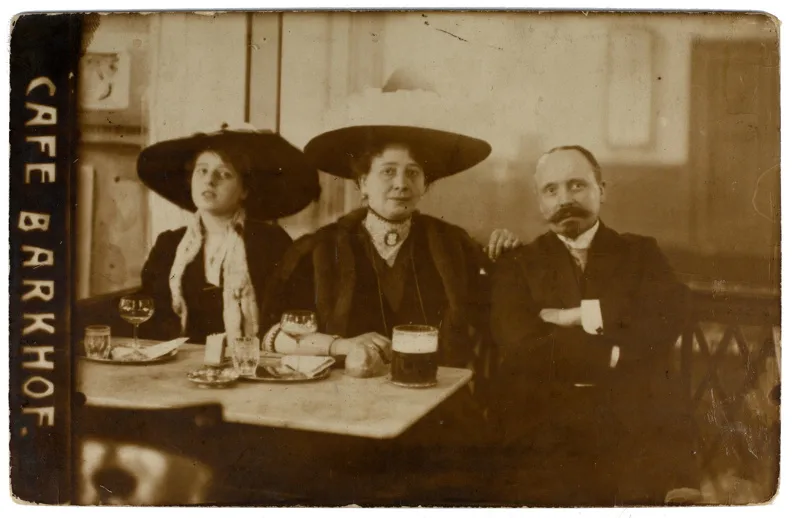
Photographers took advantage of the time guests spent there to offer portraits. After a short development time, customers received postcard-format photographs: six for two marks or twelve for three marks.
The café’s name was often printed into the photograph, making the picture both a souvenir and an advertisement.

cafe belvedere
Café Belvedere, Hamburg, 1912. Photographie Jaensch, Hamburg-Winterhude

cafe barkhofCafé Barkhof, Hamburg, 1910s. American Schnell-Atelier Albrecht Cimbal, Hamburg

Pschorr
Restaurant Pschorr Bräu, Cologne, 1910

berlin
Berlin, 1910s. Gustav Schröder, Berlin


The business model continued into the pre-war and post-war periods in other taverns and entertainment venues, including variety theatres and nightclubs.

cafe sieglerCafé Siegler, Hamburg, 1930

ballhaus trichter
Ballhaus Trichter, Hamburg-Reeperbahn, 1934

ballhaus trichter
Ballhaus Trichter, Hamburg-Reeperbahn, 1940

A vivid example of the working process appears in the silent film „Die Verrufenen" (1925) by Gerhard Lamprecht. It shows a photographer and his assistant, both living in precarious circumstances, approaching customers, setting up the camera, arranging the guests and taking the photograph. In another scene, they carry chemicals and a printing machine to a shared lavatory where the photographs are developed.

film2
film3
film4


Wilhelm Baumann’s 1902 booklet offers a contemporary account. Its title is:
‘A Thorough Introduction to Modern and Profitable Quick Postcard Photography without Special Prior Knowledge.’
Baumann describes his intended readers as ‘ordinary photographers’who wished to turn to ‘easier photography’ and establish an income in ‘busy locations’. He emphasises the low cost and straightforward operation:

‘To these advantages of postcard photography may be added … ease of production and low cost, enabling even the most economical customer to have a photograph taken without considerable expense…’


Baumann


The negative plates could be processed and contact-printed onto postcard paper rapidly in an improvised laboratory. Guests thus received their pictures within a short time: portable, ready for posting and ideally suited as souvenirs.

cafe belvedere
Café Belvedere, Hamburg, 1912. Photographie Jaensch, Hamburg-Winterhude

cafe wallhof
Café Wallhof, Hamburg, 1910

cafe eldorado
Café Eldorado, Hamburg-Altona, 1913. ‘Elite’ Zentrale für Schnellphotographie

Konzerthaus clouKonzerthaus Clou, Berlin, 1910s. Kunstverlag Paul Kaufmann, Berlin

urba's burghof
Urban’s Burghof, Cologne, 1910s

cafe belvedere
Café Belvedere, Hamburg, 1913. Photographie Jaensch, Hamburg-Winterhude


The growing popularity of the practice was closely linked to advances in photographic technology. Affordable cameras, fast lenses and tripods made photography in available light possible. Photographers could work spontaneously, producing pictures with a particular sense of immediacy and closeness.
In marked contrast to the carefully arranged studio photographs of the period, these pictures reflected the atmosphere of the venue: lively, informal and close to everyday life.

cafe barkhofCafé Barkhof, Hamburg, 1912. American Schnell-Atelier Albrecht Cimbal, Hamburg

cafe belvedere
Café Belvedere, Hamburg, 1910. Magnus Mannheim, Hamburg

cafe wallhof
Café Wallhof, Hamburg, 1910. Magnus Mannheim, Hamburg

A camera, tripod and a few materials could therefore establish a profitable business without substantial investment. Modest equipment and brief training were enough to generate a regular income, probably often in close cooperation with the owners of the venues.
Quick photography consequently became a flourishing business in many places.


kaffeehaus WalhofKaffeehaus Wallhof, Hamburg, 1910s

dammtor cafe
Dammtor Café, Hamburg, 1915

cafe belvedere
Café Belvedere, Hamburg, 1912. Photographie Jaensch, Hamburg-Winterhude


Today these photographs have considerable documentary value. They show fashion, gestures and social interaction, offering a direct view of everyday life and coffee-house culture in the early twentieth century. They reveal the close connection between commercial interests and technical innovation, and how this produced pictures whose historical value only becomes fully apparent with the passage of time.

cafe barkhofCafé Barkhof, Hamburg, 1912. American Schnell-Atelier Albrecht Cimbal, Hamburg

cafe eldorado
Café Eldorado, Hamburg-Altona, 1910. ‘Elite’ Zentrale für Schnellphotographie

cafe westminster
Café Westminster, Hamburg-Altona, 1912. ‘Elite’ Zentrale für Schnellphotographie

kaffeehaus wallhof
Kaffeehaus Wallhof, Hamburg, 1910s


Further examples are available in this magazine as a PDF download:

titel cafe

assets/stories/kaffeehaus/cafe.pdf


View the collection:
sammlung