ONE PHOTOGRAPH, ONE STORYHAMBURG · 1960s

A thousand
faces.

One Signature.

The craft of portrait photography – photographs from Mathilde Ross’s Hamburg studio.

READ THE STORY

In Front of the Camera

In one photograph, a boy with neatly parted hair looks serious; in the next, he smiles at the camera. An older woman wears a string of pearls. A man is dressed in a suit and tie, while the women have carefully styled their hair. Some look grave and thoughtful, others offer a hesitant smile or a broad one. Some seem at ease, others a little self-conscious.

They have all made an effort for their photographs. They want to look their best and trust that the woman behind the camera knows her trade.

These photographs come from Mathilde Ross’s studio in Hamburg. Many were probably taken for passports or identity cards, others perhaps for job applications or personal use. Some were also printed in the larger postcard format. They are ordinary portraits of the kind once made in countless photographic studios.

But a closer look reveals just how much care went into them.

The lighting is balanced without flattening the faces. Gentle shadows give them definition, the eyes are clearly visible, and a little extra light picks out the hair. Ross paid attention to how each person held their head, where they looked and which expression suited them best.

The photographs follow a recurring pattern, yet hardly any two faces seem alike.
One Ear Must Be Visible

Seen side by side, the portraits reveal a striking similarity. Many heads are turned slightly to one side. The faces are not strictly frontal, and one ear is often clearly visible.

There was a practical reason for this.

A 1950 decree from the Federal Ministry of the Interior required identity-card photographs to show the face in half-profile, with one ear clearly visible. Passport regulations issued in 1961 contained similar requirements.

Some aspects of these photographs were therefore prescribed. The photographer could not simply choose any pose she liked.

But there was still room for judgement. Which side was more flattering? How far should the head be turned? From which direction should the light fall? Should the person look serious or smile?

Even within these constraints, the portraits were remarkably varied.

In Search of the Best Pose

It is fortunate that so many negatives and prints from Mathilde Ross’s studio have survived. The collection probably spans more than a decade of photographic work. Keeping negatives for possible reorders was common practice. Today, this working archive offers a rare insight into her photographic craft.

The sequences are particularly revealing. For some sitters, three, four or even five different photographs survive.

Often the only differences are a slight turn of the head, a change of gaze or the hint of a smile. Yet such small adjustments can give a face an entirely different expression.

The Archive System.

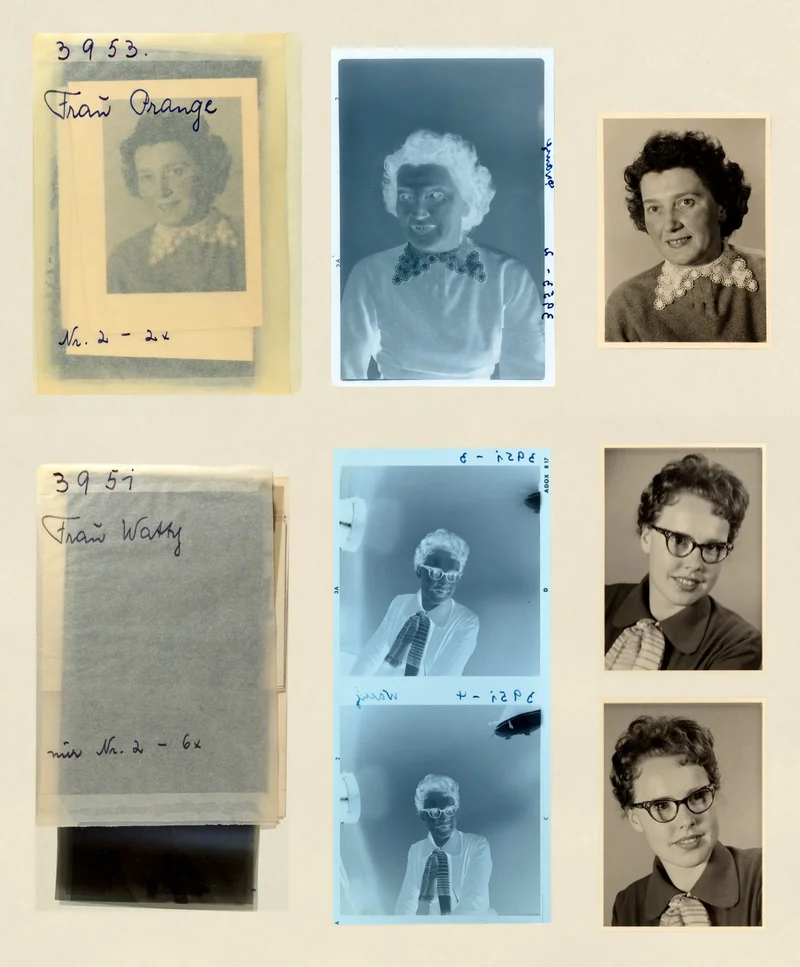
The Mathilde Ross filing system: portrait prints, negatives and handwritten storage envelopes
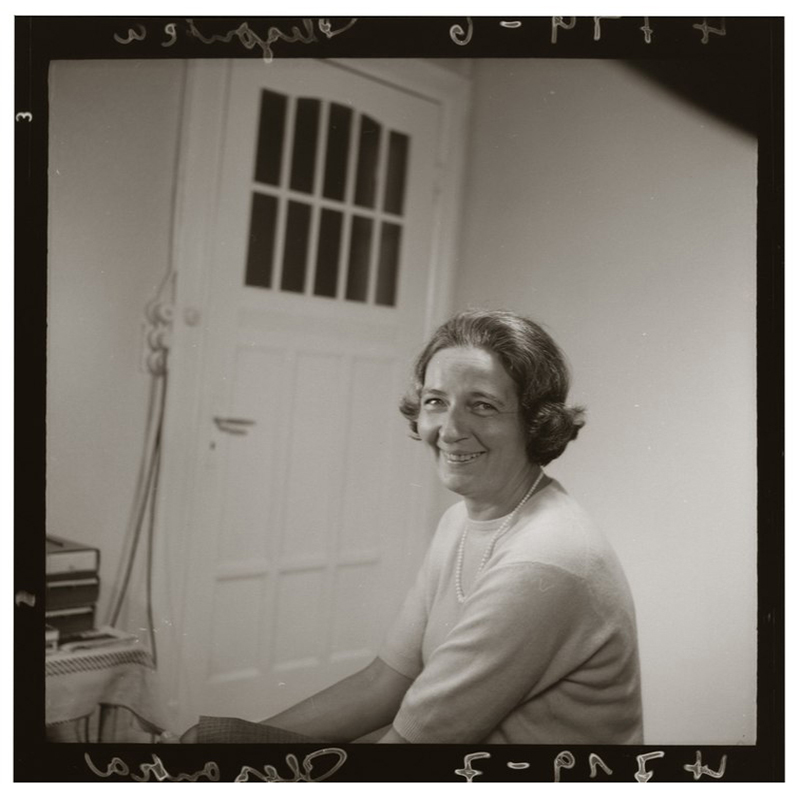
Negative showing a seated woman and a door in the studio
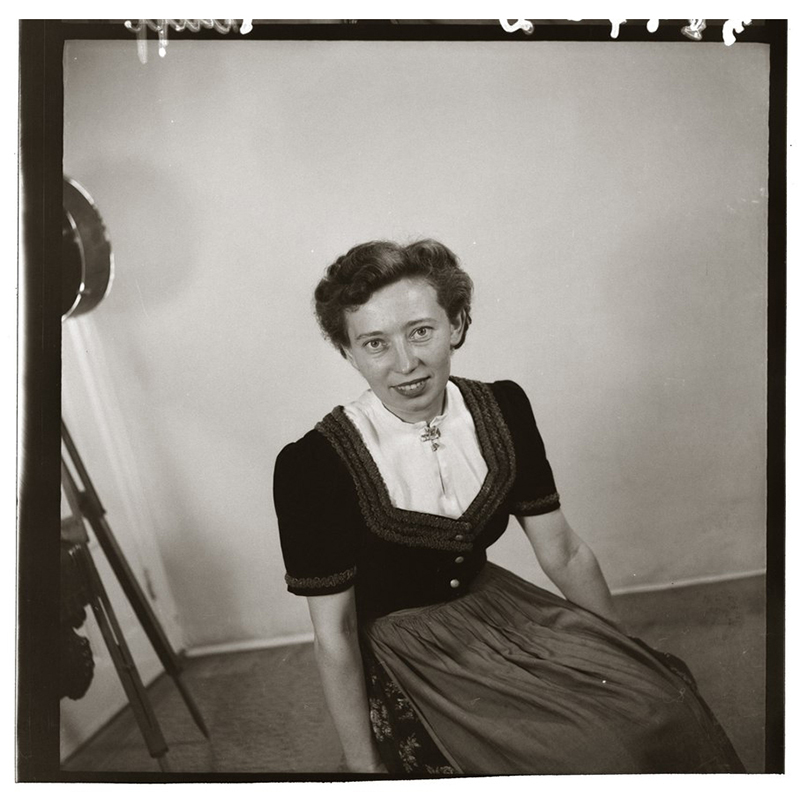
Negative showing a seated woman and a studio light

Behind the Scenes

Sometimes the negatives reveal more than the photographer originally intended. At the edges of certain frames we catch sight of a door, lighting equipment or parts of the shooting area that do not appear in the finished passport photographs.

The surroundings seem simple and functional. Whether Ross worked in a purpose-built studio or perhaps in rooms also used as living quarters cannot be established with any certainty from these details.

A Photographer We Know Little About

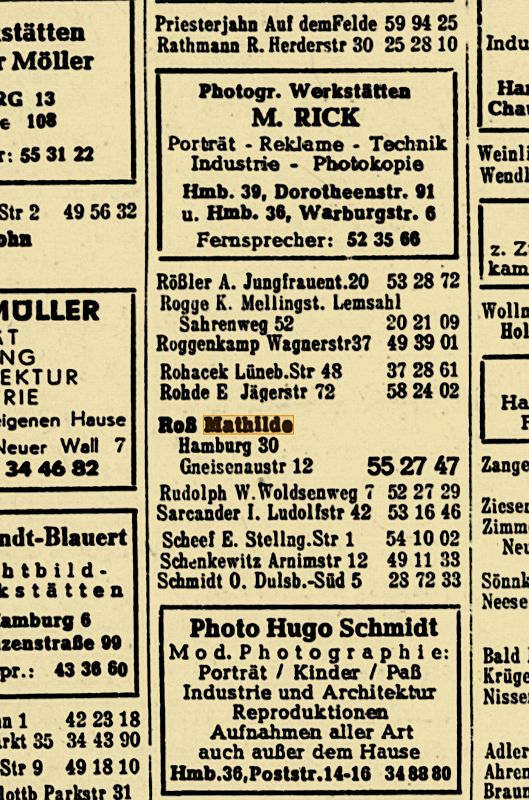
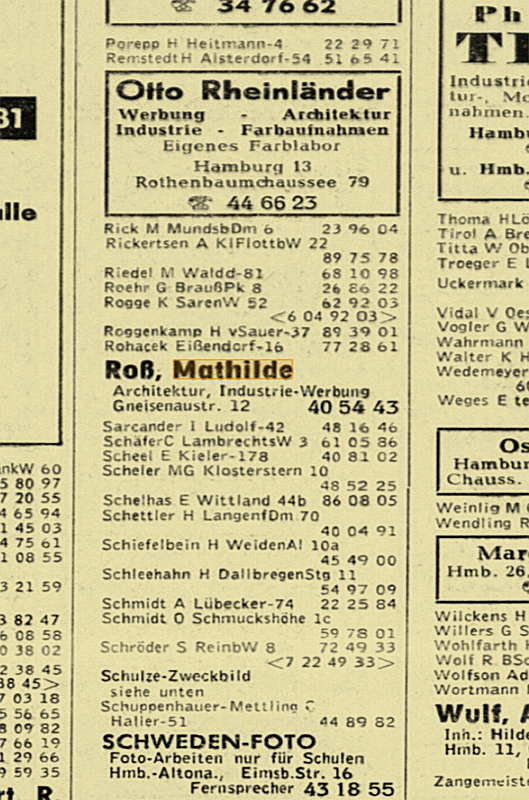
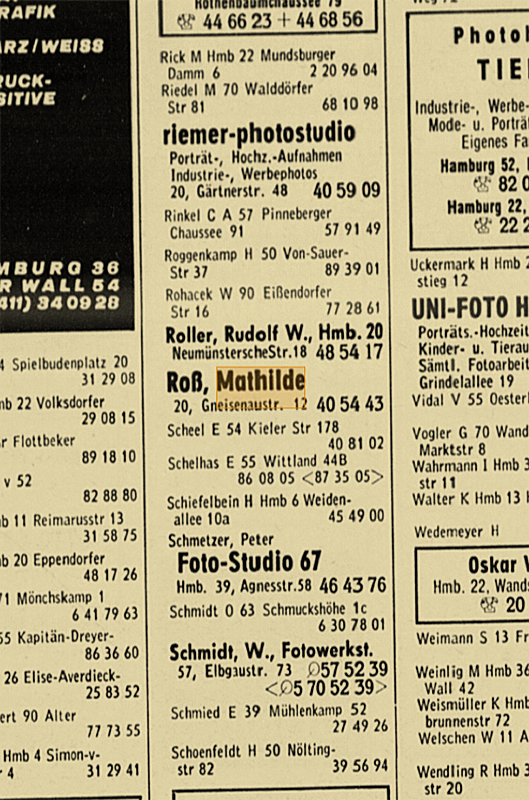
It was the occasional studio stamp on the back of her passport photographs, bearing her name and the Hamburg address Gneisenaustraße 12, that made it possible to trace her professional activity.

She appears in Hamburg trade directories between 1949 and 1968. Most entries give only her name, address and telephone number. A more detailed listing from 1961 also advertises architectural, industrial and advertising photography. Her photographic services therefore extended beyond portraiture.

Decades later, the surviving negatives and prints resurfaced in separate groups at flea markets and through online sales. How the original collection became dispersed is unknown. Around a thousand photographs survive in the collection assembled here, but many of their original connections have been lost.

The photographs themselves are now our most important source for understanding her work.

The Overlooked Portraits

The history of photography often focuses on famous photographers and extraordinary images. Everyday utilitarian photography, by contrast, has received far less attention, although for generations it accounted for a large part of photographic work.

These photographs were taken in a studio much like many others at the time. Passport and identity photographs were part of the everyday work of the photographic trade. They had to serve their purpose, present people in a flattering light, and be produced as quickly and inexpensively as possible. That required experience and skill.

The portraits from Mathilde Ross’s studio show, above all, people from everyday life in Hamburg during the postwar decades. No one seems to stand out in particular. The photographs were not extraordinary works of art, nor were they intended to be. They show faces one might have encountered every day. That is precisely what makes this collection special.

A thousand faces, photographed for entirely ordinary purposes. And yet each image bears something of her distinctive touch.

Sources and Notes

Historical regulations

  • Federal Minister of the Interior: Personalausweise (Identity Cards), decree of 31 October 1950, published in Gemeinsames Ministerialblatt no. 15, 10 November 1950, p. 103. Requirements relating to photograph size, half-profile and a visible ear. View scan.
  • Federal Minister of the Interior: regulations on passport administration, Gemeinsames Ministerialblatt no. 18, 4 September 1952. View scan.
  • Federal Minister of the Interior: Allgemeine Verwaltungsvorschriften zum Paßgesetz (General Administrative Regulations under the Passport Act), published in Gemeinsames Ministerialblatt, 20 September 1961, p. 657, no. 16. View scan.

The photographic trade

  • German Confederation of Skilled Crafts (Zentralverband des Deutschen Handwerks): Die Handwerksordnung (Crafts Code), referring to the legislation of 1953. Website.
  • Federal Institute for Vocational Education and Training (BIBB): Genealogie Fotograf/Fotografin (Occupational History of the Photographer), covering the relevant professional regulations from 1953, 1957, 1962 and 1963. Website.
  • Fritz Schmidt / Hans W. Dußler: Gehilfenprüfung im Fotografen-Handwerk (Journeyman’s Examination in the Photographic Trade), various editions, including 1949 and 1951.
  • Heinrich Freytag: Meisterprüfung im Fotografen-Handwerk (Master Craftsman’s Examination in the Photographic Trade), Düsseldorf, 6th–7th ed., c. 1965.

Mathilde Ross

  • Hamburg address and trade directories, entries identified to date from 1949 to 1968, including a more detailed listing from 1961 advertising architectural, industrial and advertising photography.
  • Studio stamp found on the backs of individual passport photographs.