A photograph and its story
Quick portraits
at Kaufhof
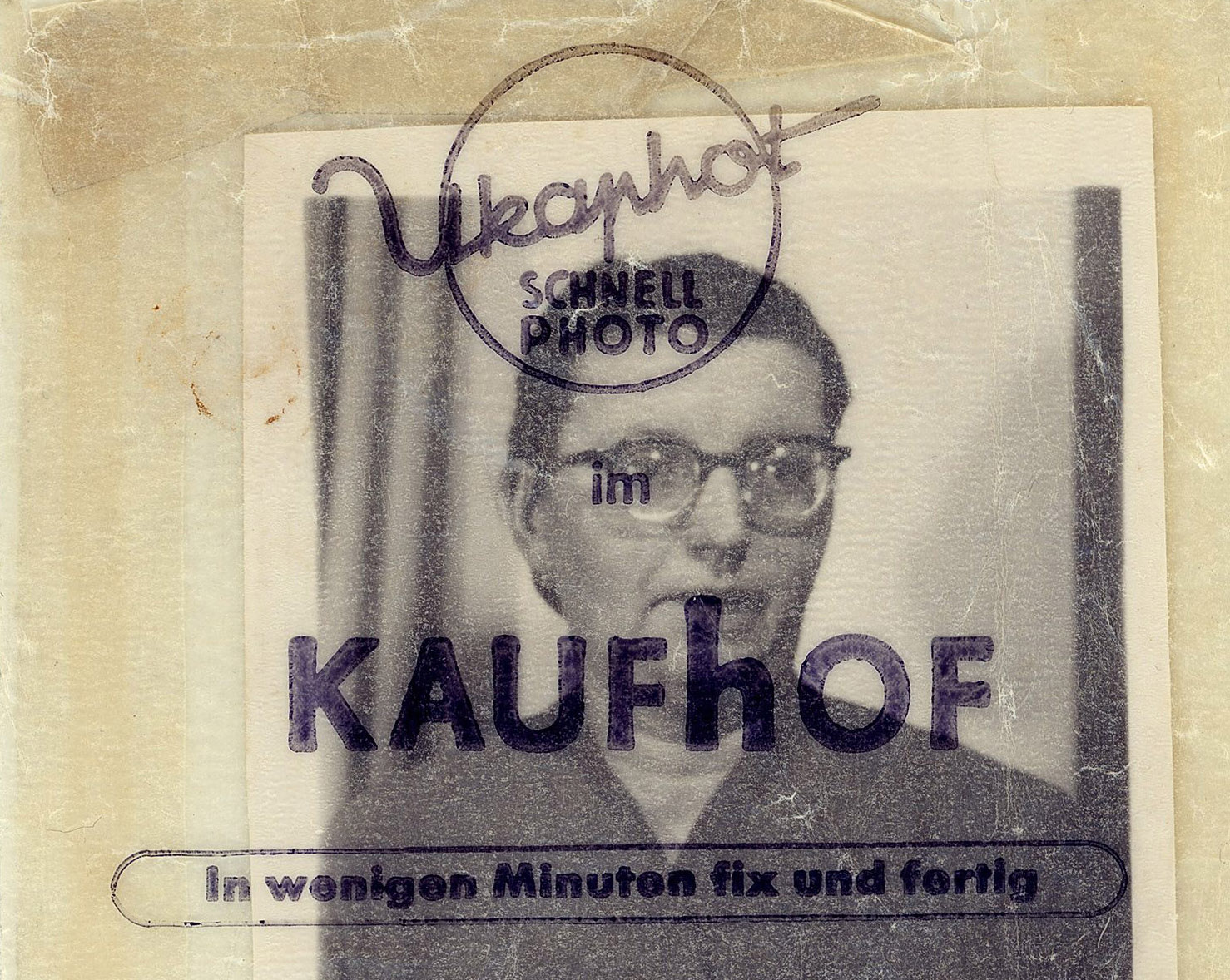
A small portrait in a sleeve and an unusual camera.
Read the story ↓A woman looks into the camera. It is a typical passport portrait: quick and straightforward to make, suitable for identification documents of many kinds. Such photographs were inexpensive and readily available.
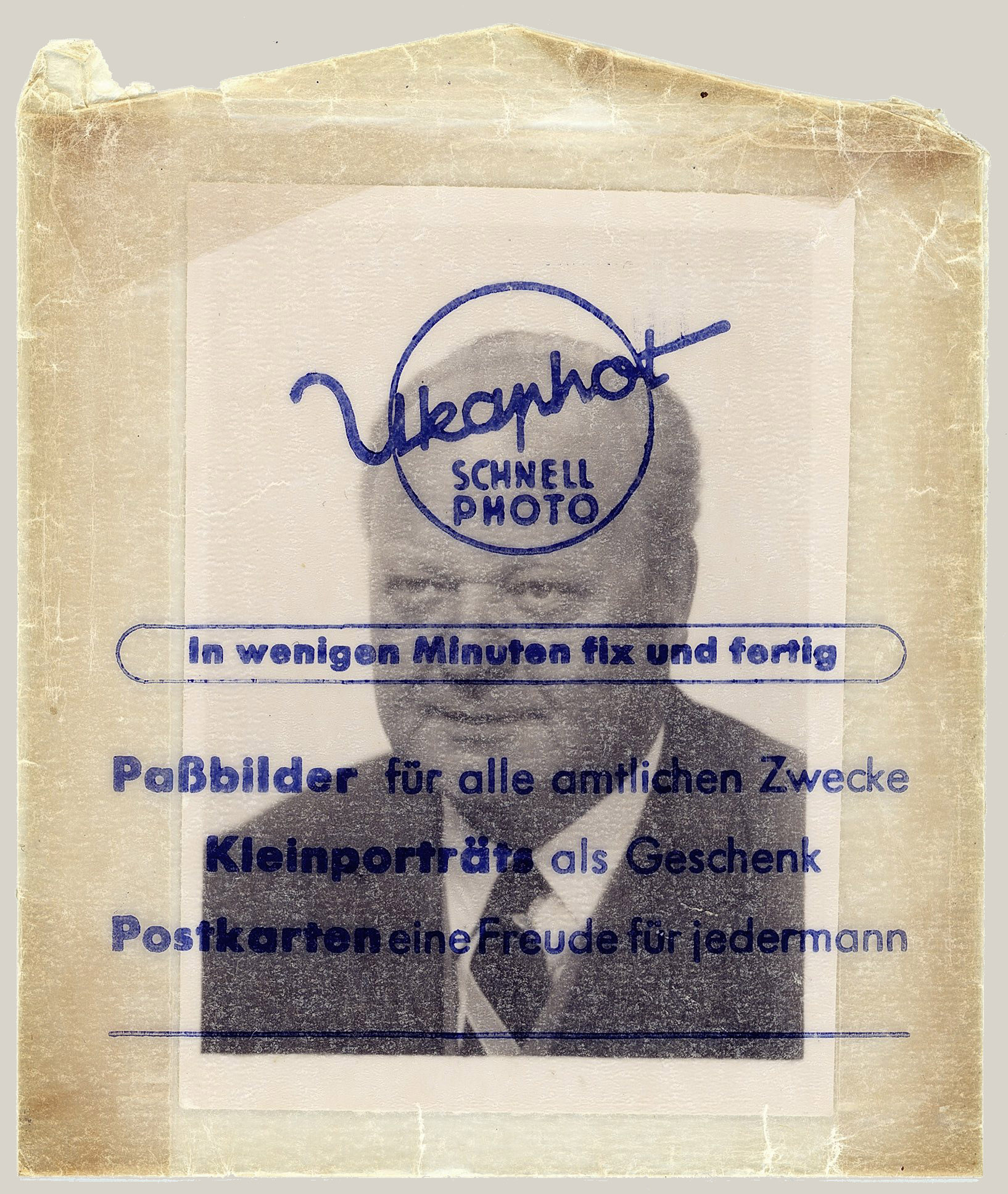
We do not know who she was. Yet the photograph tells us something about how it came into being. It was part of a service in which customers were photographed at a department store and could take the finished picture away soon afterwards. The print sits in a glassine sleeve marked “Ukaphot Schnell Photo im Kaufhof” and promises “In wenigen Minuten fix und fertig” (“Ready in just a few minutes”). The back of the print bears the marks “Ukaphot” and “Gevaert”.
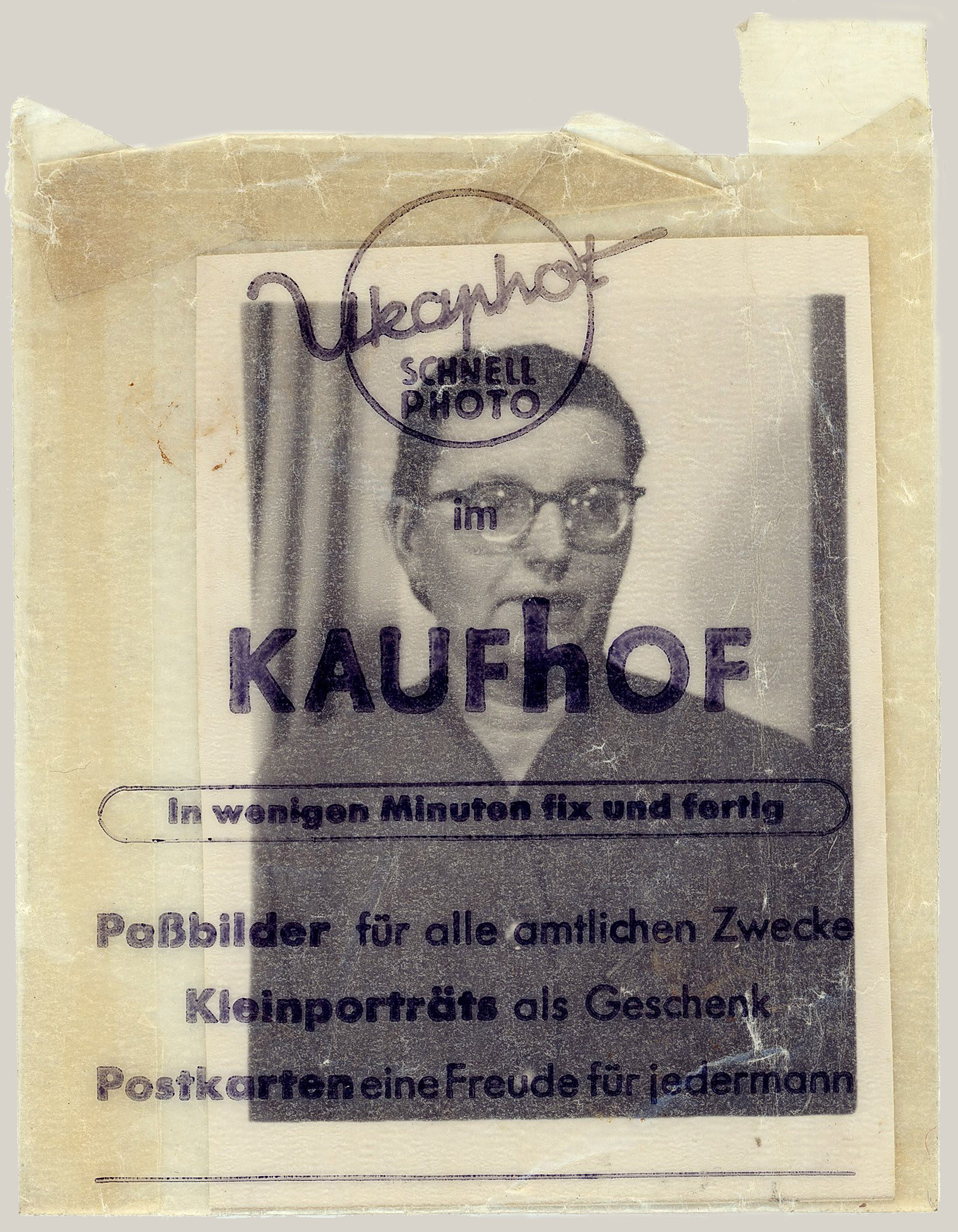
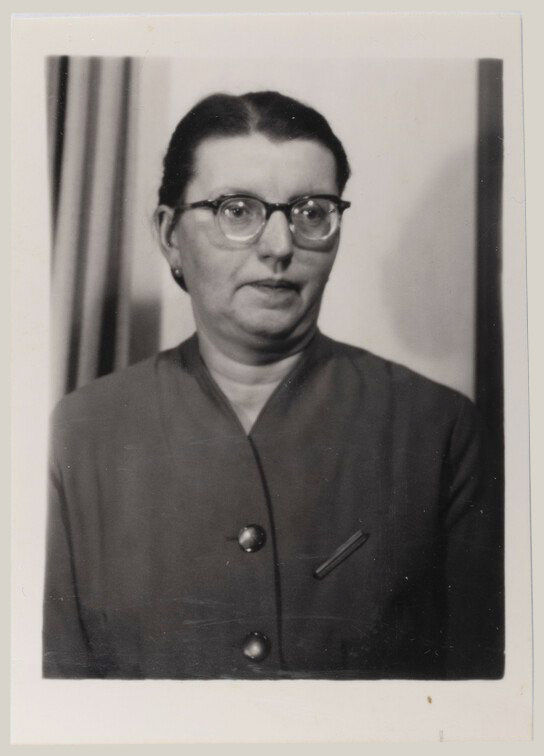
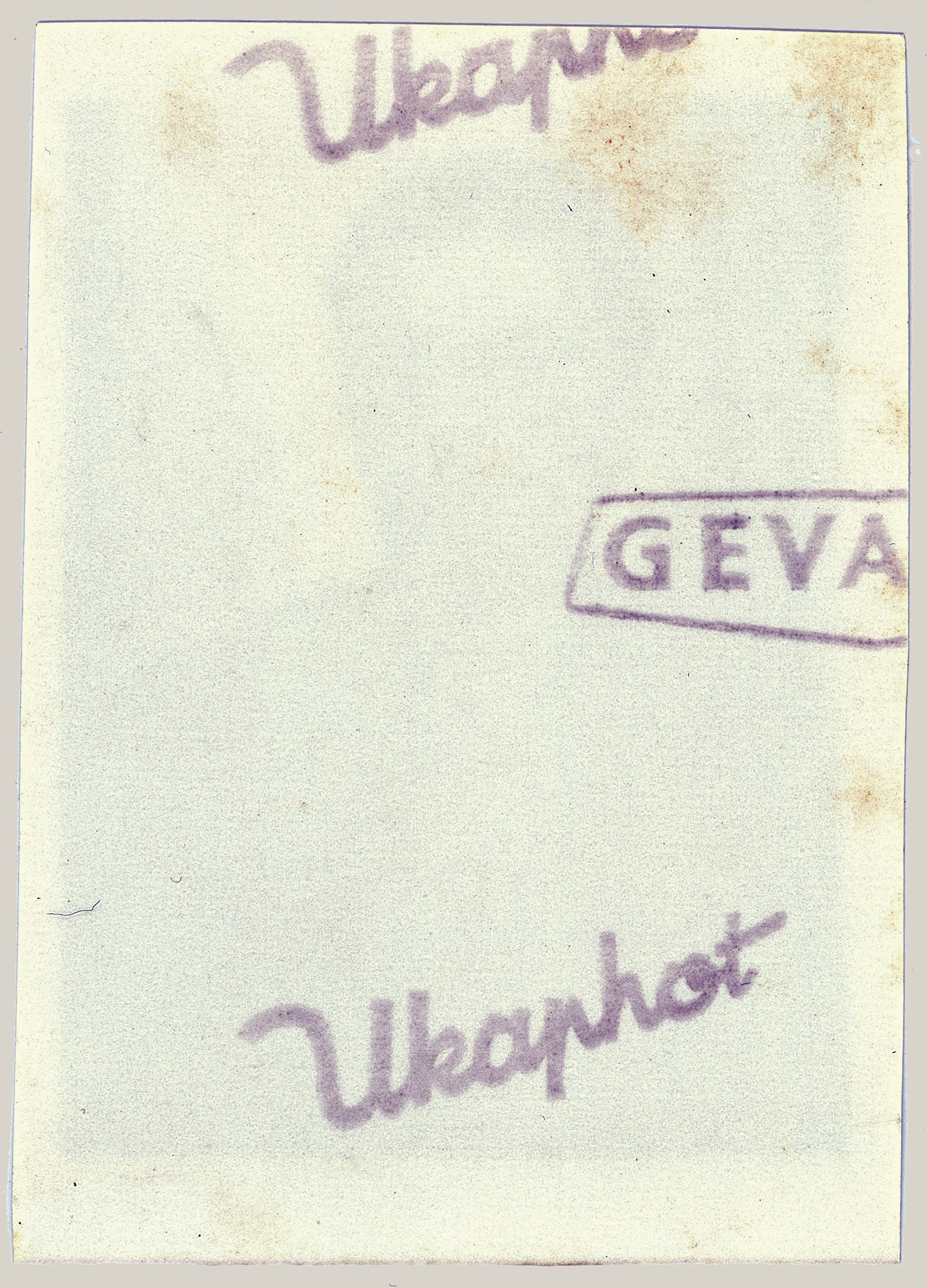
Rapid portrait of an unknown woman in a glassine sleeve and the reverse of the print.
Photography had been part of the department store business long before the 1950s: dedicated photographic studios opened in Berlin stores from 1898. Inexpensive portraits were intended to bring customers into the building; if customers had to return to collect their prints, that meant another visit. In the 1910s and 1920s, standardised rapid portraits followed. Their small prints could also be used as passport or identification photographs.
Passport portraits had long been among the services offered by many department stores. They were often available near the entrance, where they also reached people who needed only a quick photograph. This suited the store: visitors coming in for a photograph, or waiting for their prints, might look around and make another purchase.
Before the curtain or a white wall
The portraits show a simple but changing backdrop. In some, a folded curtain fills the whole background. In others it is only partly drawn; still others were taken against a plain background.
The poses follow a pattern: the sitters look directly into the camera or just past it. Their heads and shoulders face forward or turn slightly to one side. Their faces are clearly visible, and the frame shows the head and upper body, as in the passport photographs explicitly advertised on the Kaufhof sleeve.
The pictures feel fleeting: a brief glance at the camera, a simple pose, and the picture was taken. They are everyday photographs that could be made spontaneously, finished quickly and produced at little cost.
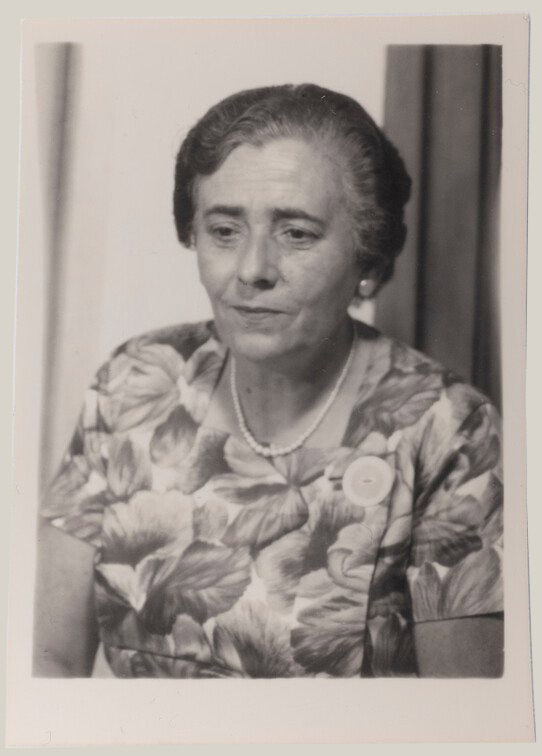
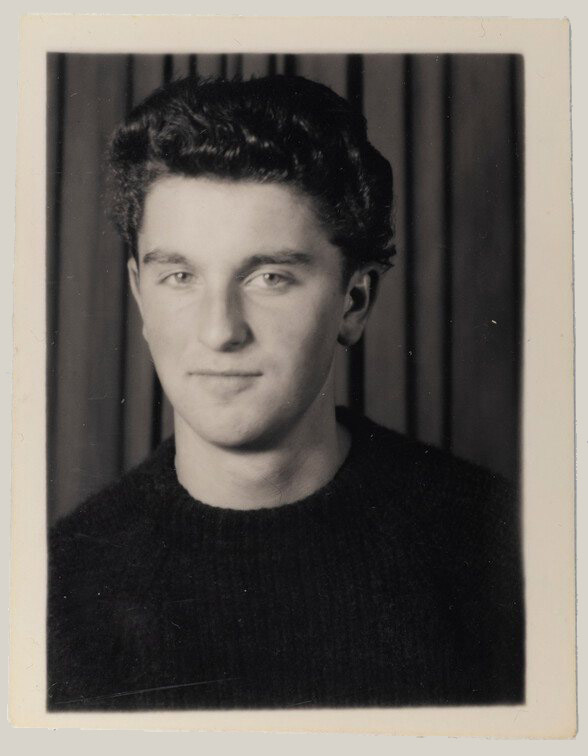
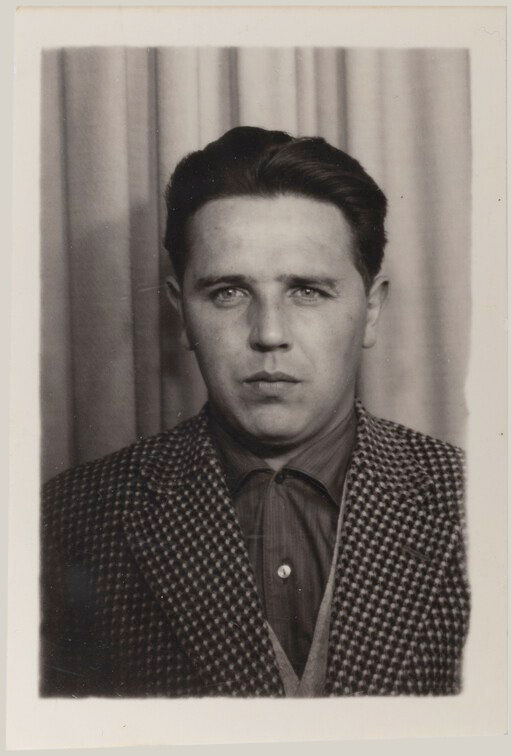
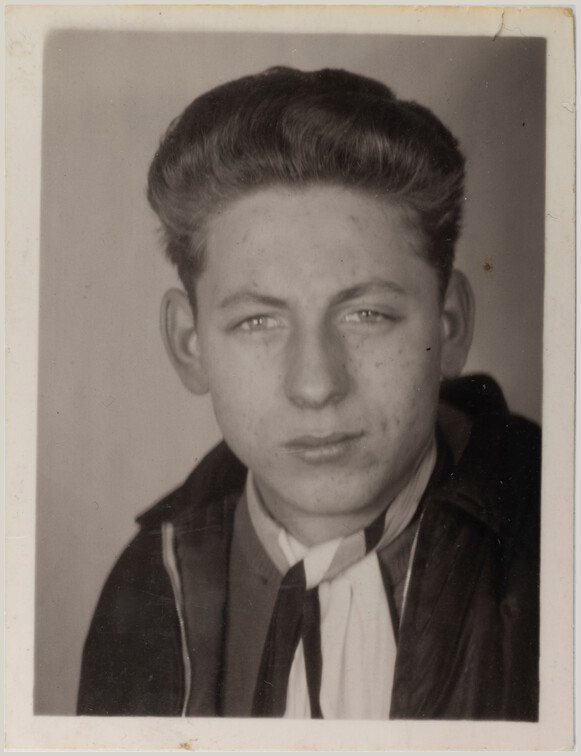
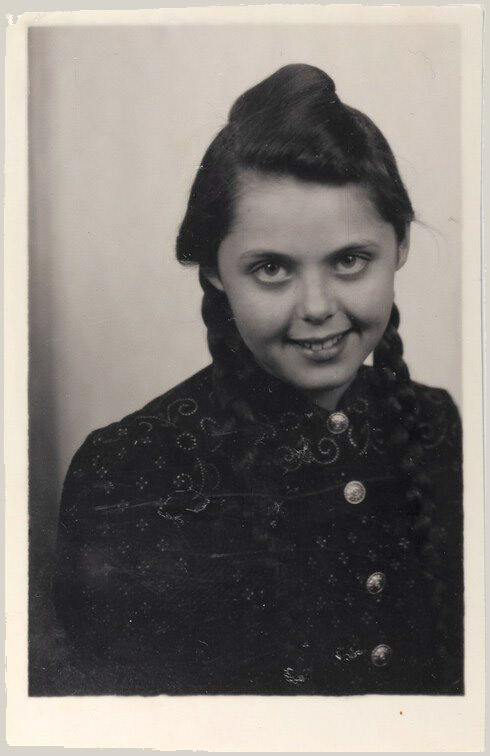
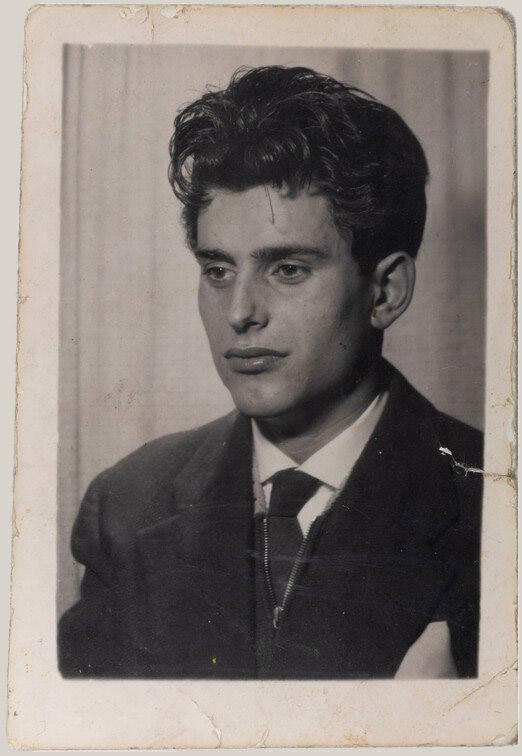
Passport-format portraits with the reverse-side imprint “Ukaphot – Gevaert”.
fix und fertig““Ready in just a few minutes”
The technology behind the rapid portrait
Behind the name Ukaphot was a photographic process using a special camera. While ordinary cameras exposed film and required a negative before a paper print could be made, the Ukaphot recorded the image directly on photographic paper.
An early account appeared in the Westfälische Zeitung on 29 November 1949:
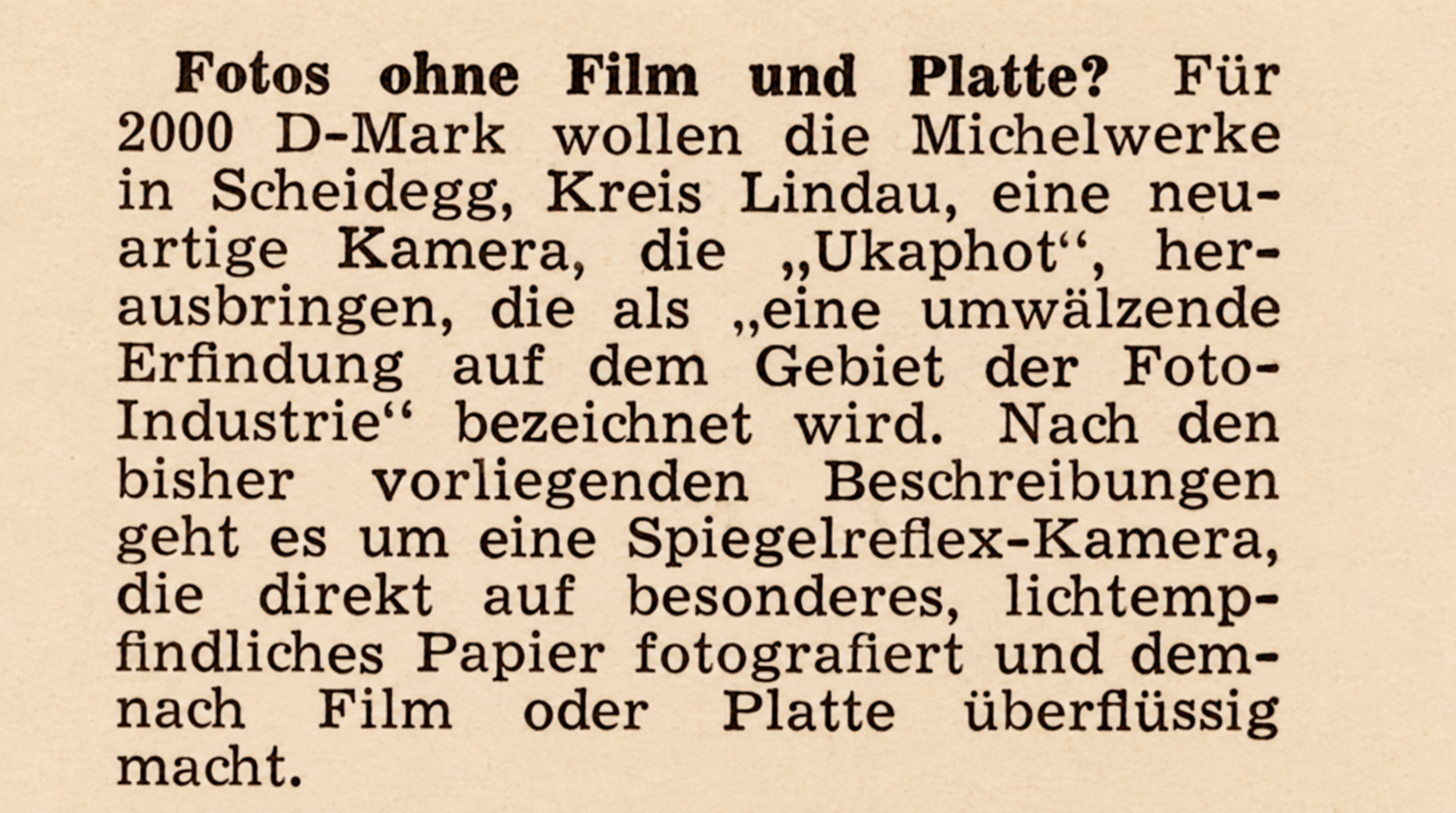
“Photographs without film or plates? The Michelwerke in Scheidegg, Lindau district, plan to bring out a new kind of camera, the ‘Ukaphot’, for 2,000 Deutsche Marks. It is described as ‘a revolutionary invention in the photographic industry’. According to the descriptions available so far, it is a reflex camera that photographs directly onto special light-sensitive paper, making film or plates unnecessary.”
An advertisement in a photography handbook uses the distinctive “Ukaphot” lettering, which also appears on the backs of the photographs, to identify v. Rötel, Zeller & Co. in Lindau on Lake Constance and describes the direct process:

“v. Rötel, Zeller & Co., general partnership, Lindau on Lake Constance, Gängle 4–6. Ukaphot direct process for black-and-white and colour in the shortest possible time; special camera and special colour-reversal equipment.”
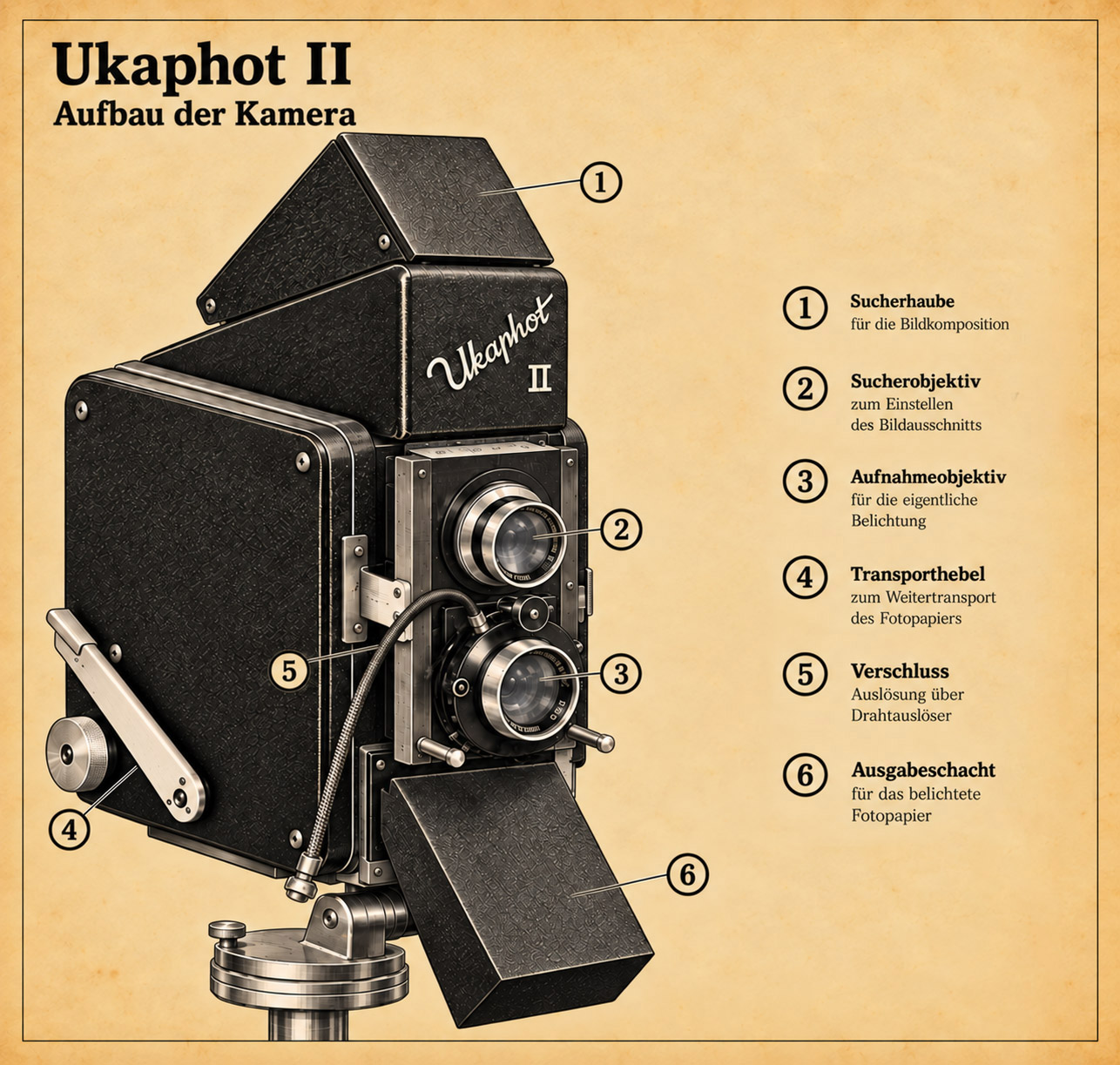
A trade-fair report from 1952 and the catalogue for photokina 1956 describe the camera as follows:
Unter der Bezeichnung „Ukaphot II“ stellte die Firma v. Rötel, Zeller & Co. OHG, Lindau/B., eine neue, zweiäugige Spiegelreflexkamera für Direktaufnahmen der Größe von 9×14 cm vor, mit der ohne Negativ seitenrichtig direkt auf ein von der Firma Gevaert, Antwerpen, geliefertes Umkehrpapier Paßbilder oder Aufnahmen in den Größen 5×7, 7×9 und 9×14 cm hergestellt werden. Diese Kamera mit dem gesamten Zubehör ist eine der bemerkenswertesten Neuerscheinungen der Messe, sofern man diesen Ausdruck auf ein Gerät anwenden darf, das sich schon im Laufe des letzten Jahres in großem Umfang bewähren konnte und auch für die Zwecke der Paßphotographie eingesetzt wurde.
“Under the name ‘Ukaphot II’, v. Rötel, Zeller & Co. of Lindau introduced a new twin-lens reflex camera for direct 9 × 14 cm photographs. Without a negative, it produces correctly oriented passport photographs or pictures in sizes 5 × 7, 7 × 9 and 9 × 14 cm directly on reversal paper supplied by Gevaert of Antwerp. The camera and its accessories are among the most remarkable new products at the fair, if that term can be applied to a device that had already proved itself widely over the preceding year and was also used for passport photography.”
Ein sogenannter Schnellphotoautomat, d.h. eine zweiäugige Spiegelreflexkamera mit Xenar 4,5/180mm und Parallaxenausgleich. Als Aufnahmematerial wird ein Spezial-Umkehrpapier in Rollen von 50 m Länge und 10 cm Breite geliefert. Das Grundformat ist 10x14 cm oder 7x10 cm. Innerhalb des Grundformates können alle beliebigen Formate eingestellt werden. Eine Kassette dient zum Auffangen der abgeschnittenen Bilder. Laborausrüstungen und Chemikalien zur Entwicklung des Umkehrpapiers sind ebenfalls lieferbar.
“A so-called rapid-photo machine: a twin-lens reflex camera with a Xenar 4.5/180 mm lens and parallax correction. The material is special reversal paper supplied in rolls 50 m long and 10 cm wide. The basic picture size is 10 × 14 cm or 7 × 10 cm; any desired size within it can be selected. A cassette collects the cut-off pictures. Laboratory equipment and chemicals for developing the reversal paper are also available.”
The Ukaphot system was not a photo booth in the sense of a self-operating cabin. The camera was operated by staff. After the exposure, the photographic paper was chemically developed. The picture was supposed to be “ready in just a few minutes,” as the advertising on the photograph’s sleeve promised. Kaufhof was only one possible setting for such a rapid photography service.
Historicbits
Find. Preserve. Make visible.
Historicbits is dedicated to historical photographs preserved in private albums, collections and estates. The project seeks out, preserves, catalogues and publishes images that might otherwise be lost or forgotten.
Its focus includes frequently overlooked forms of everyday photography: commercial photographs, amateur snapshots, local press images, studio portraits, photo booth pictures and rapid photography.
Many of these photographs were not made as art or with the aim of recording history, yet they have become valuable historical sources.
They were made to preserve memories, offer services or run a photography business. Their direct connection with everyday life makes them valuable today.
About the project